DC motor drives and where they still make sense
Direct current drives were the only practical way to vary the speed of an industrial motor for most of the twentieth century. Then power electronics made alternating current drives cheap, reliable and better in almost every respect, and the direct current drive became a legacy technology. Almost every new installation is alternating current, and anyone specifying a new direct current system today needs a specific reason. The interesting part is that such reasons still exist.
How a direct current drive differs
In a direct current machine, speed is roughly proportional to armature voltage and torque is roughly proportional to armature current. These relationships are close to linear and independent of each other, which makes control conceptually simple. A thyristor bridge supplies controlled voltage to the armature, a separate and much smaller supply feeds the field winding, and a controller regulates both.
That independence is the technology’s defining virtue. Torque is directly proportional to a current the drive measures, so torque control is immediate and accurate without needing any model of the motor. Achieving the same thing in an alternating current machine requires vector control, which calculates the equivalent quantities from measured currents and a motor model. Modern vector drives do this extremely well, but the direct current machine does it inherently.
Why alternating current replaced it
The commutator and brushes are the problem. They are the mechanism that switches current in the rotating armature, and they are mechanical components in sliding contact carrying full armature current. Brushes wear and need periodic replacement. The commutator needs inspection and occasional machining. Brush dust is conductive and spreads inside the machine. Sparking at the brushes restricts use in hazardous areas and generates electrical interference.
An induction motor has none of this. Its rotor has no electrical connection to the outside world, which means no brushes, no commutator, minimal maintenance, higher achievable speed, better power to weight ratio and a lower price. Once drives could control such a motor precisely, the case for direct current collapsed for general purpose use.
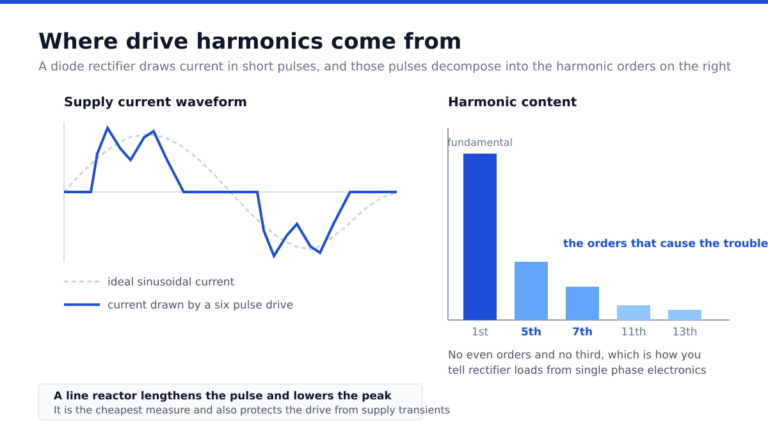
There is a supply side issue too. The thyristor bridge in a direct current drive draws distorted current and operates at poor displacement power factor at low output voltage, which makes its effect on the supply worse than that of a comparable alternating current drive. The mechanisms are described in our note on harmonics from variable frequency drives and how filters help, and they apply with greater force here.
Where direct current still earns its place
Existing installations
This is by far the largest category. Plants contain direct current machines that work, that are mechanically integrated into their application, and that are not worth replacing. When the control electronics fail, retrofitting a modern digital direct current controller to the existing motor is frequently far cheaper than replacing motor, gearbox, mounting and cabling with an alternating current equivalent. Retrofit controllers exist precisely for this market.
Very wide constant power range
Because the field can be weakened independently of the armature, direct current machines achieve a wide constant power speed range straightforwardly. Applications such as winders and some machine tool spindles, which need high torque at low speed and high speed at reduced torque, map naturally onto this behaviour.
Winding and tension control
Centre driven winders on paper, film, wire and textile machines need torque that varies continuously as roll diameter changes. Direct torque proportionality makes this control problem simpler, and many such machines were designed around direct current drives and continue to use them.
Traction and battery systems
Series wound direct current motors produce very high starting torque and have long been used in traction, forklifts and hoists, particularly where a battery provides direct current naturally. Even here, alternating current drives with inverters have taken most new designs, but the installed base is enormous.
Maintaining what exists
If you operate direct current machines, the maintenance programme is specific. Brushes are inspected for length, seating and spring pressure, and replaced as a set rather than individually. The commutator is checked for surface condition, grooving and uneven wear, and the pattern on its surface tells an experienced technician a great deal. Brush dust is removed, since it is conductive. Field winding insulation is tested, and cooling paths are kept clear.
Keep spares. Brush grades are specific to the machine and not interchangeable on a whim, and a plant depending on a direct current machine with no brush stock is a plant depending on a supplier’s lead time. The general discipline for drive and panel maintenance applies here too, as set out in our note on how to size a variable frequency drive for a motor when the time does come to convert. General background is summarised in the overview of direct current motors.
Frequently asked questions
Should I specify a direct current drive for a new installation?
Rarely. Alternating current drives with vector control match or exceed the performance for most applications with far less maintenance. A specific reason, such as integration with existing direct current machinery, is needed to justify it.
Is it cheaper to retrofit a controller or replace the motor?
Retrofitting a modern controller to a sound existing direct current motor is often substantially cheaper, because conversion to alternating current usually means replacing the motor, its mounting and sometimes the mechanical transmission.
Why do direct current motors need more maintenance?
Because brushes and the commutator are sliding mechanical contacts carrying full armature current. They wear, generate conductive dust and require periodic inspection and replacement.
Can direct current motors be used in hazardous areas?
Brush sparking makes this difficult, and special construction is required where it is permitted at all. Induction motors are generally far easier to apply in such locations.
Do direct current drives affect power quality?
Yes, and often more than comparable alternating current drives, because the thyristor bridge draws distorted current and operates at poor displacement power factor when output voltage is low.