Soft starters compared with variable frequency drives
When a motor is too large to switch straight onto the supply, there are two established answers. Fit a soft starter, which reduces the inrush during acceleration and then steps aside. Or fit a variable frequency drive, which controls the motor continuously for its whole working life. They are often quoted against each other as though they were competing versions of the same product. They are not. One solves a starting problem and the other solves a control problem.
What direct starting actually does
Connecting an induction motor directly to the supply produces an initial current several times the motor’s full load current, lasting until the rotor approaches synchronous speed. The exact multiple depends on the motor design and is stated in its data.
That inrush has two consequences. Electrically it causes voltage dip on the supply, which can disturb other equipment and may exceed what the utility or site rules permit. Mechanically it applies a torque step to the driven machine, stressing couplings, belts, gearboxes and the product being moved. Either consequence on its own is reason enough to avoid direct starting on a large machine.
How a soft starter works
A soft starter uses thyristors to control the voltage applied to the motor during acceleration, ramping it up over a set time. Reduced voltage means reduced current and reduced starting torque, and the ramp replaces the torque step with a gradual rise.
Once the motor is at speed, most soft starters close a bypass contactor and connect the motor directly to the supply. From that moment the motor runs exactly as it would have without the starter. There are no ongoing losses in the semiconductors, no harmonic distortion and no effect on efficiency.
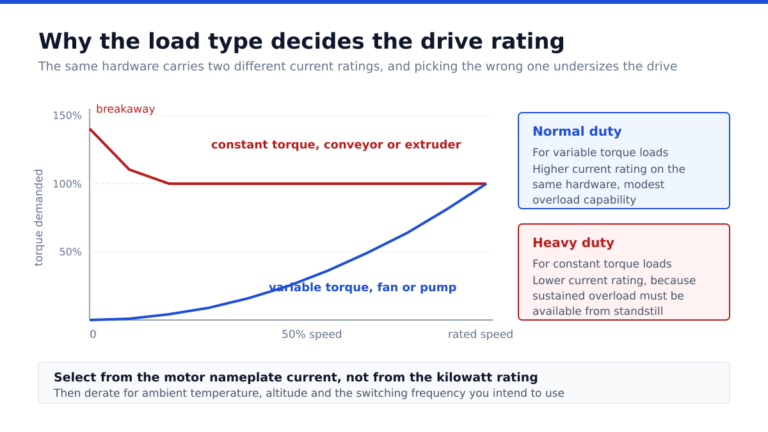
The limitation follows from the physics. Starting torque falls with the square of the applied voltage, so reducing current also substantially reduces available torque. A soft starter works where the load can be accelerated gently. It does not work where the load needs high breakaway torque, because there is no way to have low current and high torque at the same time.
How a drive differs
A variable frequency drive rectifies the incoming supply and synthesises a new output of adjustable voltage and frequency. Because it controls frequency, it can produce full torque at low speed, which a soft starter fundamentally cannot. Starting current can be held close to full load current while delivering rated torque from standstill.
The more important difference is what happens afterwards. The drive stays in circuit and controls speed for the whole operating life of the machine. On a centrifugal fan or pump, where power varies roughly with the cube of speed, running at reduced speed instead of throttling produces energy savings that generally dominate every other consideration in the comparison.
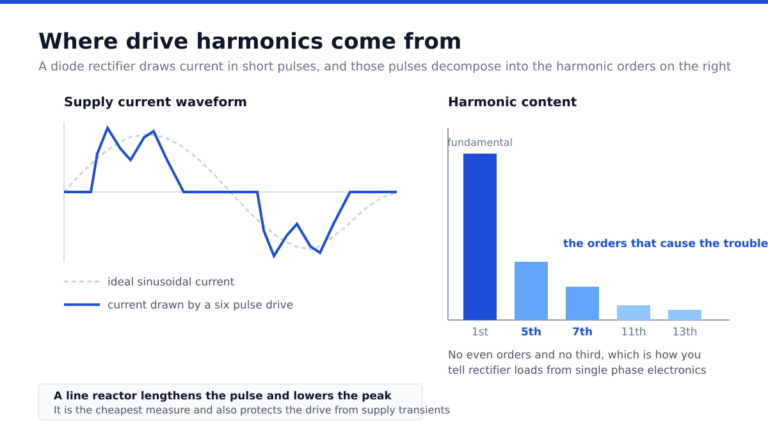
The drive also brings costs. It remains in the power path, so its own losses are continuous. It draws non sinusoidal current and injects harmonics into the supply. It produces fast voltage transitions that stress motor insulation and can drive bearing currents on larger machines. And it is a more complex device with more to configure and more to fail.
Choosing between them
Cases where a soft starter is the right answer
The motor runs at one speed, and that is all the process needs. The load accelerates without needing much torque, as with a fan or a centrifugal pump that is not starting against pressure. The supply is weak and harmonic distortion would be a problem. Panel space or ambient temperature limits what can be installed. Or the installation is a straightforward replacement of an existing starter where the process will not change.
Cases where a drive is the right answer
The process benefits from variable speed, for either energy or quality reasons. The load needs substantial torque from standstill, as with a loaded conveyor or a positive displacement pump. Precise speed or torque control is required. Controlled deceleration or braking matters. Or the machine starts and stops frequently, where a drive handles repetitive duty more comfortably.
The honest summary
If the answer to the question what speed should this run at is always the same number, a soft starter is probably sufficient and will cost less, lose less energy and cause fewer supply side complications. If the answer is it depends, a drive will repay its extra cost, usually quickly, on any centrifugal load.
Where a drive is selected, sizing it correctly is a separate exercise with its own pitfalls, set out in our note on how to size a variable frequency drive for a motor. General background on reduced voltage starting is summarised in the overview of motor soft starters.
Frequently asked questions
Does a soft starter save energy?
Not in normal running. It reduces starting current and mechanical stress, but once bypassed the motor runs at full supply voltage exactly as it would without one. Energy savings come from variable speed, which requires a drive.
Can a soft starter handle a high breakaway torque load?
Generally no. Reducing voltage to limit current also reduces torque by the square of the voltage ratio. Loads needing high starting torque need a drive.
Do drives cause problems on the supply?
They draw non sinusoidal current and inject harmonics, which may require filters or reactors depending on the size of the drive relative to the supply and the limits that apply at the site.
Can both be used on the same motor?
There is no reason to. A drive already provides controlled starting, so a soft starter in series adds cost and losses without benefit.
Which is more reliable?
A bypassed soft starter is out of circuit during running, which is an inherent advantage. A drive is continuously in the power path and carries more components, though modern drives are robust when correctly specified and cooled.