Heat loss and cooling inside a drive enclosure
Of every hundred units of electrical energy entering a variable frequency drive, a small number do not come out the other side as useful power. They come out as heat, inside the enclosure, and that heat has to go somewhere. Thermal design is the least visible part of a drive installation and one of the most common reasons drives fail years earlier than they should.
How much heat and from where
A modern drive is efficient, typically converting the large majority of input power with losses in the low single digit percentages. That sounds negligible until it is expressed in watts. A drive handling a substantial motor produces losses measured in hundreds of watts, continuously, inside a sealed metal box. Manufacturers publish the dissipation figure for each model at rated load, and that figure, not a percentage, is what belongs in the calculation.
The losses come from three places. Switching losses occur each time a semiconductor changes state, so they scale with switching frequency. Conduction losses occur while current flows through the devices, so they scale with load. Losses in the direct current link components, the control electronics and any internal fan make up the remainder.
The switching frequency relationship is the one installers control and often overlook. Raising the carrier frequency to quieten a motor increases losses, which both heats the enclosure further and reduces the drive’s own current capability, as covered in our note on how to size a variable frequency drive for a motor.
Why internal temperature decides service life
The component that usually limits a drive’s life is the electrolytic capacitor in the direct current link. Its electrolyte degrades with temperature, and the relationship is strongly non linear. A commonly cited engineering approximation holds that capacitor life roughly halves for each ten degree rise in operating temperature. Whatever the precise figure for a given component, the direction is unambiguous and the effect is large.
This is why two identical drives, one in a ventilated panel and one in a sealed cabinet in a hot plant room, can have service lives that differ by years. Nothing visible distinguishes them. The difference is entirely in the thermal environment.
Drives protect themselves by derating or tripping on overtemperature before damage occurs, which is useful but is a symptom rather than a solution. A drive that trips on hot afternoons in summer is telling you the enclosure cannot shed the heat it produces.
Getting the heat out
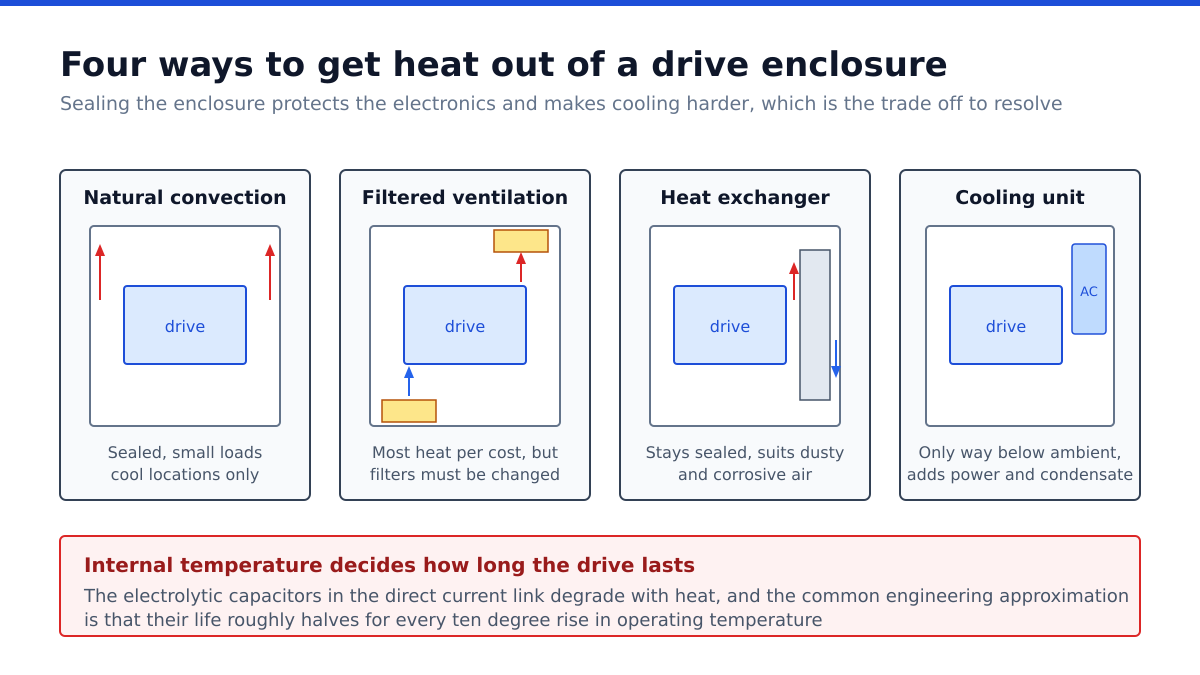
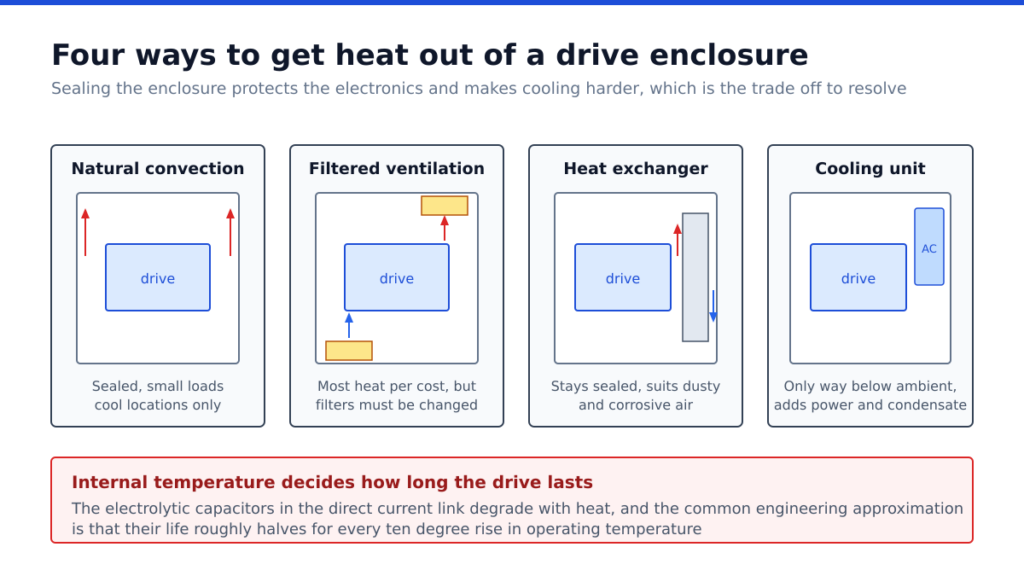
Natural convection
A sealed enclosure sheds heat through its surface by conduction and convection, and the capacity depends on surface area, material and the temperature difference with the surroundings. For small drives in cool locations this suffices. The calculation is straightforward and the manufacturer of the enclosure publishes the figures. Mounting matters, because an enclosure against a wall has less effective surface than a free standing one.
Filtered forced ventilation
A fan drawing ambient air through filters and exhausting it through a vent moves far more heat than convection alone and is the most common arrangement in industrial panels. Its weakness is the filter. A blocked filter turns a ventilated enclosure into a sealed one without changing its appearance, and filter replacement is the single most neglected maintenance item in control panels. Where outside air is dusty, oily or corrosive, drawing it through the panel also carries contamination onto the electronics.
Air to air heat exchangers
These transfer heat from inside to outside without mixing the air streams, keeping the enclosure sealed. They suit dirty or humid environments where ventilation would bring in contamination, and they move less heat per unit cost than ventilation but need no filter changes.
Air conditioning and cold plate cooling
Where ambient temperature is high or where internal temperature must be held below ambient, a cooling unit is the only option. It brings its own power consumption, condensate management and maintenance requirement. Some larger drives also support cold plate or liquid cooling, mounting the heatsink outside the enclosure entirely, which is an elegant solution where the infrastructure exists.
Practical detail that changes outcomes
Respect the clearances in the manual. Manufacturers specify space above and below a drive because the internal airflow path depends on it, and stacking drives tightly to save panel width throttles their own cooling.
Mount drives so that air moves upward past them, with cooler components low and hotter ones high, and do not place a drive directly beneath something heat sensitive. Separate drives from control electronics where possible, both thermally and for the interference reasons discussed in our note on PLC panel design, from signal count to wiring discipline.
Calculate for the worst case, not the average. The relevant ambient is the plant room on the hottest afternoon of the year with the doors closed, not the temperature on the day of commissioning. And monitor it, because most drives report heatsink temperature over their communication interface, which makes a slow trend toward the trip threshold visible long before the first trip.
General background on enclosure protection and environment is summarised in the overview of the IP code.
Frequently asked questions
How do I find out how much heat a drive produces?
The manufacturer publishes power dissipation in watts for each model at rated load. Use that figure rather than estimating from an efficiency percentage.
Why does a drive trip only in summer?
Because the enclosure cannot shed its heat at the higher ambient temperature. The thermal design was adequate for mild conditions and not for the worst case.
Does switching frequency affect cooling?
Yes. Higher switching frequency increases losses, raising enclosure temperature and reducing the drive’s continuous current rating at the same time.
Is ventilation always better than a sealed enclosure?
It moves more heat but draws in whatever is in the air and depends on filters being maintained. In dusty, oily or corrosive environments a sealed enclosure with a heat exchanger is usually the better choice.
How often should panel filters be changed?
It depends entirely on the environment, and the only reliable guide is inspection. A blocked filter is indistinguishable from a clean one from outside the panel, which is why it is so often missed.